As services organizations grow, quoting becomes harder to manage. Deals involve complex requirements, regional pricing, margin pressure, and constant market change. What once lived in spreadsheets, emails, and one off tools becomes difficult to scale and even harder to trust.
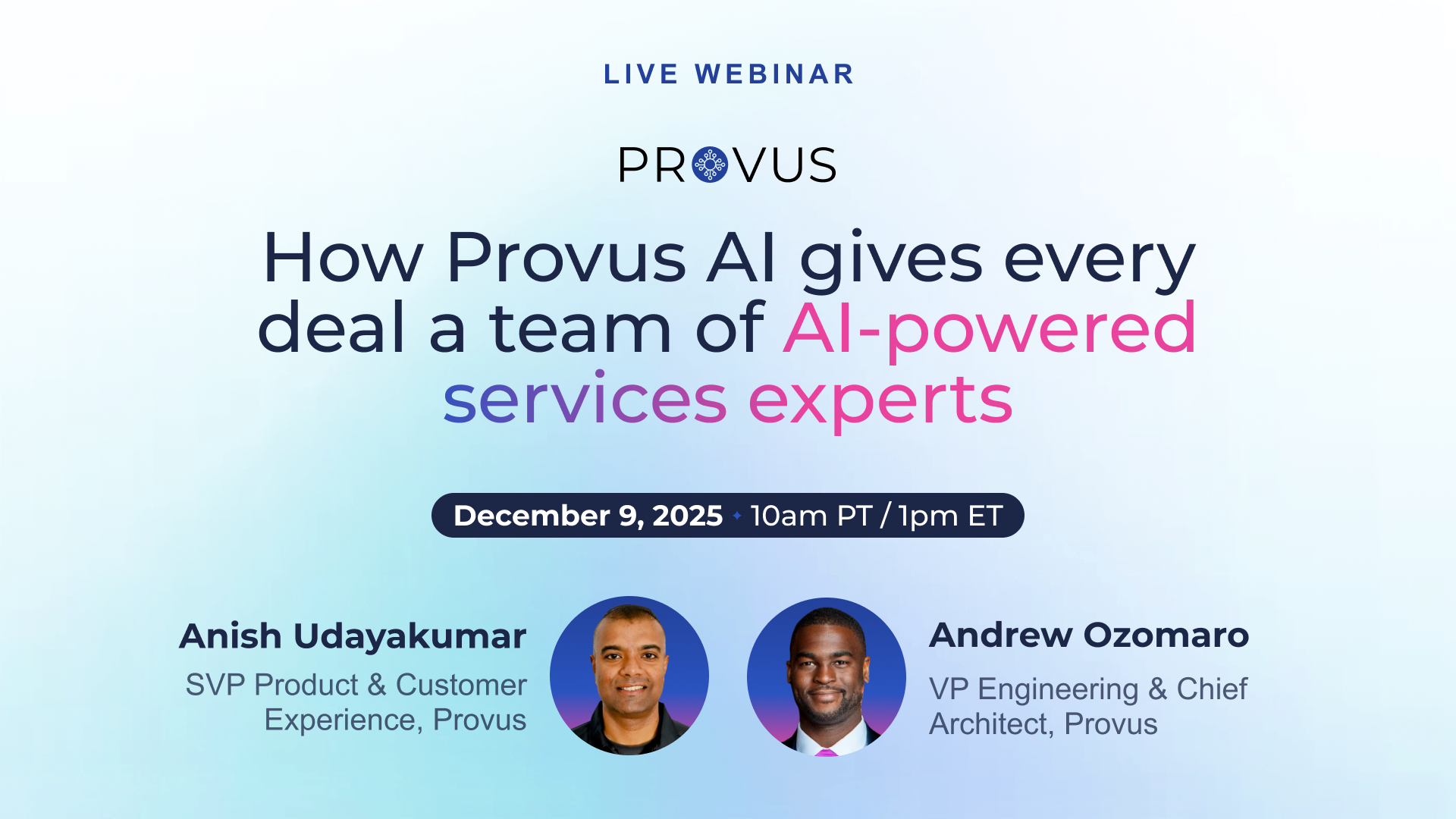
In a recent webinar, Anish Udaykumar, SVP of Product Management and Customer Experience at Provus, and Andrew Ozomaro, VP of Engineering and Chief Architect, shared how Provus AI was built to support sellers directly in the flow of work by embedding agentic AI into services quoting.
Get the full breakdown below, and rewatch the webinar at any time.
The gap between discovery and pricing
Services teams are expected to move faster while deals themselves continue to get more complex. Sellers must digest long discovery documents, RFPs, and call notes, translate unstructured inputs into accurate scope and pricing, and protect margin across regions, skills, and delivery models.
As Anish explained during the session, “quoting for global services deals always takes a long time,” and teams often struggle because “they haven’t truly been able to spot the right pricing signals, the market signals and the right data points to price accurately.”
Without better support, sellers are forced to rely on fragmented context and manual review, which increases risk as deal volume grows.
Provus AI takes a services team first approach
Provus designed its AI strategy around how service teams actually work. Rather than pushing AI into a separate tool or interface, the goal was to elevate outcomes inside the quote itself.
“We have kept the seller as the focal point of our AI strategy,” Anish said, explaining that Provus intentionally “created an AI experience wrapper around the seller.”
Each deal in Provus includes an agentic interface where AI works alongside the seller, providing guidance, insights, and recommended actions in context instead of forcing sellers to jump between systems.
What Provus AI helps teams do
1. Turn discovery into usable scope in minutes
Discovery is often where deals slow down first. Sellers spend hours translating discovery calls, RFPs, and dense requirements into something usable for scoping and pricing, and important details are easy to miss.
In the webinar, Andrew demonstrated uploading a 50 page GDPR requirements document and quickly generating a structured snapshot. “Through a simple upload, I was able to generate and know about the GDPR requirement,” he said. “So, in about two minutes, I got a snapshot that’s perfect for my project.”
Instead of producing a generic summary, Provus AI surfaces the information that most often causes downstream issues. As Andrew noted, “usually, that’s where we see most of our customer projects have an issue where they incorrectly estimated the timeline.”
2. Optimize quotes without relying on fragmented context
Once a quote is created, sellers are often asked to adjust pricing, margin, or delivery assumptions while keeping the deal competitive. This is where complexity compounds.
As Andrew put it, “services pricing is inherently complex.” That complexity comes from geography, skills, labor models, and customer-specific constraints that are difficult to evaluate consistently across deals.
Provus AI supports sellers by analyzing quotes against internal and external data, flagging margin and utilization risks, and prompting questions sellers may not have considered.
Just as importantly, it keeps decision making transparent. Sellers can see how recommendations were formed and trace insights back to the data behind them.
As Andrew explained, “you can query the patterns to really understand why this agent came to do what it did.”
3. Generate scenarios faster and with more confidence
Creating multiple scenarios is time consuming and often repetitive. Sellers typically copy existing quotes, adjust a few variables, and hope nothing important is missed.
Provus AI automates this process by generating multiple pricing and delivery scenarios based on the deal context and discovery inputs.
In the demo, Andrew showed how the system surfaced compliance requirements that would have taken several review cycles to catch manually. “This is something that I missed as a sales rep that would have taken many, many cycles,” he said.
4. Monitor deals as conditions change
Deals rarely stay static. Regulatory updates, cost shifts, and competitive moves can all impact pricing and margin long after a quote is created.
According to Anish, “AI is the only way in which you can really watch regulatory changes, competitive moves, and pricing signals in real time.” Provus AI continuously monitors these signals and flags when a deal may be at risk.
When that happens, Andrew explained, the system surfaces “things that might need urgent attention, things that it’s watching,” giving sellers the opportunity to intervene before a deal stalls or margins erode.
5. Use agents designed as digital employees
Provus AI agents are built to behave like digital employees rather than generic chatbots. As Anish described it, “we have created and designed our agents to be your digital employees.”
Each agent is role based, goal driven, and policy aware by default. Teams decide how much responsibility agents take on, from advisory only to executing defined actions. “You can control the level of access,” Anish said, “and you can control the level of autonomy.”
How services teams put Provus AI to work
Provus AI was designed to work with existing systems and data, without forcing teams into a large transformation project.
“You don’t have to move your data to Provus AI platform to start off,” Andrew explained. Teams can connect structured and unstructured data sources, define access controls, and set autonomy levels while keeping data in their own environment.
The bottom line for services teams
Provus AI helps services teams move faster through discovery, price with greater confidence, reduce risk tied to changing conditions, and scale expertise across every deal.
By embedding agentic AI directly into the quoting workflow, sellers gain the support of digital services experts that surface risks early, explain recommendations clearly, and adapt as market signals shift, without forcing teams to change how they work.
As Anish summarized, Provus AI enables teams to “harness the power of AI to reduce the risk, scale our margins, and win with confidence.”
Ready to put a team of agentic, digital services experts to work? Get a personalized demo of Provus AI.